Do you know that in Abruzzo you can find a beautiful,
traditional jewellery called Presentosa?


Presentosa is a traditional jewellery from Abruzzo, a gold pendant with a very refined filigree technique. This jewellery is handmade by skilled goldsmiths.  Presentosa comes in yellow and white gold, with or without gems.
The filigree of the jewellery represents symbols in different shapes and each shape has a different meaning: one heart in the middle means that the girl is single.


Two hearts, the girl who wears it is engaged. Two hearts joined by a crescent reversed moon shape means the girl is married.

Nowadays Presentosa is a gift for many different occasions and the symbols used varied: a dove is used for the baptism, communion and confirmation; a mirror is the symbol against bad luck and slanders.

Originally the Presentosa was related to the rituals of engagement, in fact it used to be offered to young women as a promise of love. The word comes from "presente", a present, a gift, which then turned into "presentenza" and "presentosa" in the local dialect.

The jewellery is a perfect gift representative of the region Abruzzo and its traditions.


Source: Abruzzo Rural Property

Although there is no characteristic mask-figure in Abruzzo, there are still various rituals and propitiatory customs connected with the Carnival. Among these customs we must mention the dances known as "lu saltarello" and the "lacci d'amore", a famous tradition at Sant'Andrea, the smashing of cooking pots and the greasy pole.

In Guardiagrele on the day of the carnival, people dresses in traditional clothes. Men wear a hat with a flower into the band or are dressed as carnival characters: the lawyer, the judge, the professor, the doctor, the captain, the merchant. Local women goes to church dressed in traditional long, black skirts with strips of brighter clothes and aprons, blouses decorated with handmade lace, handmade wooden shawls, and gold pendants.

In Schiavi d’Abruzzo, on the Carnival day, also known as “martedi’ grasso”, young men from the village dress up in funny carnival clothes allwearing a huge paper hat representing a bouquet of flowers and roses. These guys are called Mazzaroni in local dialect,  they stroll the streets of the village singing, playing and dancing a traditional dance called La Spallata, pushing each other shoulder against shoulder. They goes door to door performing their amusing show and asking for sweets, food and wine.

In Molise, Carnival is characterised by an atmosphere that takes back to Pagan rituals and  is celebrated in a darker way than in many other regions of Italy where it is characterised by colourful masks, parades, amusing jokes and games. Molise celebrates the Carnival in a deeplysymbolic way.

At Carpinone, Roccasicura and Forli del Sannio, the carnival puppet “Fantoccio” is burned at the stake, in the main square of the village where a huge fire burns in front of the villagers.

At Sant'Agapito the “Fantoccio” is thrown off a cliff. At Castelnuovo al Volturno near Rocchetta al Volturno a man is dressed as a deer andis eventually caught by a hunter performing ceremonial rituals. At Tutara there is the procession of the devil.

The cheese game of Vinchiaturo is something cheerer, in fact men competes in team by throwing large rounds of cheese of 15 km down the streets. This competition is called "Lancio della Ruzzola".


Source: Abruzzo Rural Property

Story of a successful property purchase in Abruzzo
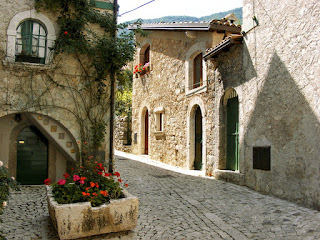

Town house in abruzzo, italy
Village in Abruzzo

  We always went to Italy for our holidays and loved the country. For several years I used to look at various property sites on the internet to get a feel of what you got for your money in the different regions.
In 2011 we spent 6 weeks travelling around Italy (also France, Spain and Malta) to make sure we definitely wanted to buy in Italy and then to settle on a region. 
 
We decided upon southern Abruzzo and spent the next 6 months searching for the right property. We were looking for something to renovate as we had done this is the UK and it would be a project for us.

We nearly bought a charming house in the mountains but as on one trip it was under offer we found a complete ruin only one mile from the sea and a wonderful promenade. Then the one in the mountain came back on the market so we had a dilemma. We sat at the airport pondering the pros and cons of both but the one near the beach won and we have never regretted it....

Only 35 minutes from the airport and 2 miles from the motorway exit and you can even walk to the station. Also the weather seemed more settled there. Shops not far and the nearest large town only 10 minutes drive. We hit it lucky too with the estate agent's assistant who dealt with our sale. She was very proactive and kept us informed of progress all the way along.

We employed an italian solicitor in London and he dealt with all the legal side and selected the notary in Italy and the sale went through relatively smoothly. I would do this again as he acted solely for us whereas the notary acts for the state. The agent helped us with the codice fiscale and opening an Italian bank account. I researched and found a foreign currency broker, which has been great and hassle free in purchasing euros and transferring money over to wherever in Italy at a moments notice. 

We made the offer in November, completed in person the following March and started the renovation in June.  We used a local geometra to check out a few things for us and I think the one we found was exceptional, we asked about his past projects and he put us in touch with a previous client. He thoroughly recommended him and he turned out to be fantastic and transformed our ruin to one to move into in only six months.

Most of our communications was done by email with a couple of visits in between. He would send us regular updates with photos and we made stage payments via our foreign currency broker in the UK so we could transfer funds the same day.

My language skills are that of an intermediate but it has improved as the whole renovation was communicated in Italian. I think the secret of a successful renovation has been finding a trustworthy and competent geometra (who has since become a firm friend). He stuck to his estimate, any extras being changes we instigated.

The locals are so friendly and we have made several friends there already, mainly Italian but also expats like us. We have sourced things in local shops and that helps us integrate into the local village. We used someone found on an Abruzzo expat site to transport some furniture out.      
We probably will spend about a third of our time there (we have our children and good friends in the UK, and wouldn't want to leave them permanently), sometimes going by car and the rest by plane, cheap flights are always available.

We love the beauty and variety of the region, rolling hills, mountains, agricultural landscapes, mountains, sea, climate of course.
We can ski in a resort which is only one hour away.
We retired just before the house was finished. We now have years to explore the many villages and towns nearby and venture to Naples, Rome and the south just a few hours away.

Starting from scratch with a ruin has been a challenge but so rewarding seeing the end result.    
We now also have a new interest as we have a small vineyard and we are slowly learning about vitriculture with the help of the previous owner/farmer. My husband has just completed a course on vineyard maintenance at our local (UK) agricultural college. We have also started to have friends and family stay with us when we are there and doubtless to say the children will use the place more when they get their own families.


Source: Abruzzo Rural Property

Sweet Fiadoni, Easter Pastry

Ingredients
________________________________________


For pastry dough
2 eggs
2 tablespoons vegetable oil
2 tablespoons sugar
Four as needed (about 1 1/2 cups)


For filling
1 egg
1 container of ricotta, strained
4 teaspoons sugar

* Fiadone (singular) or fiadoni (plural) were originally known as "h'iatun'" or "hiadone" in the Molise countryside. However tourist brochures from this region now refer to them as "fiadone." On the world-wide web this style of cheese pastry has many different names, including: fiadone con ricotta, fiadone al ricotta, fiadone di ricotta, fiadoni con ricotta, fiadoni al ricotta, fiadoni di ricotta, fiadone dolce, and sweet fiadone.


Directions
________________________________________


  1. Mix the pastry dough ingredients and work into a fine dough.
  2. Let the dough rest for four to six hours.
  3. Divide the dough into small portions and pass it through the pasta machine (but not to the last number, should not be too thin). Pastry dough resembles lasagna noodles.
  4. Pipe small mounds of filling on pastry noodle; cut into portions.
  5. Press together pastry pockets with fork.
  6. Make tiny air vents on top of the pastry pockets.
  7. Brush with beaten egg.
  8. Bake in a shallow greased and floured pan in a 325 degree oven for fifteen to twenty minutes.


Italian video recipe:   https://www.youtube.com/watch?v=y8CWDGqq6V4


Source: Abruzzo Rural Property